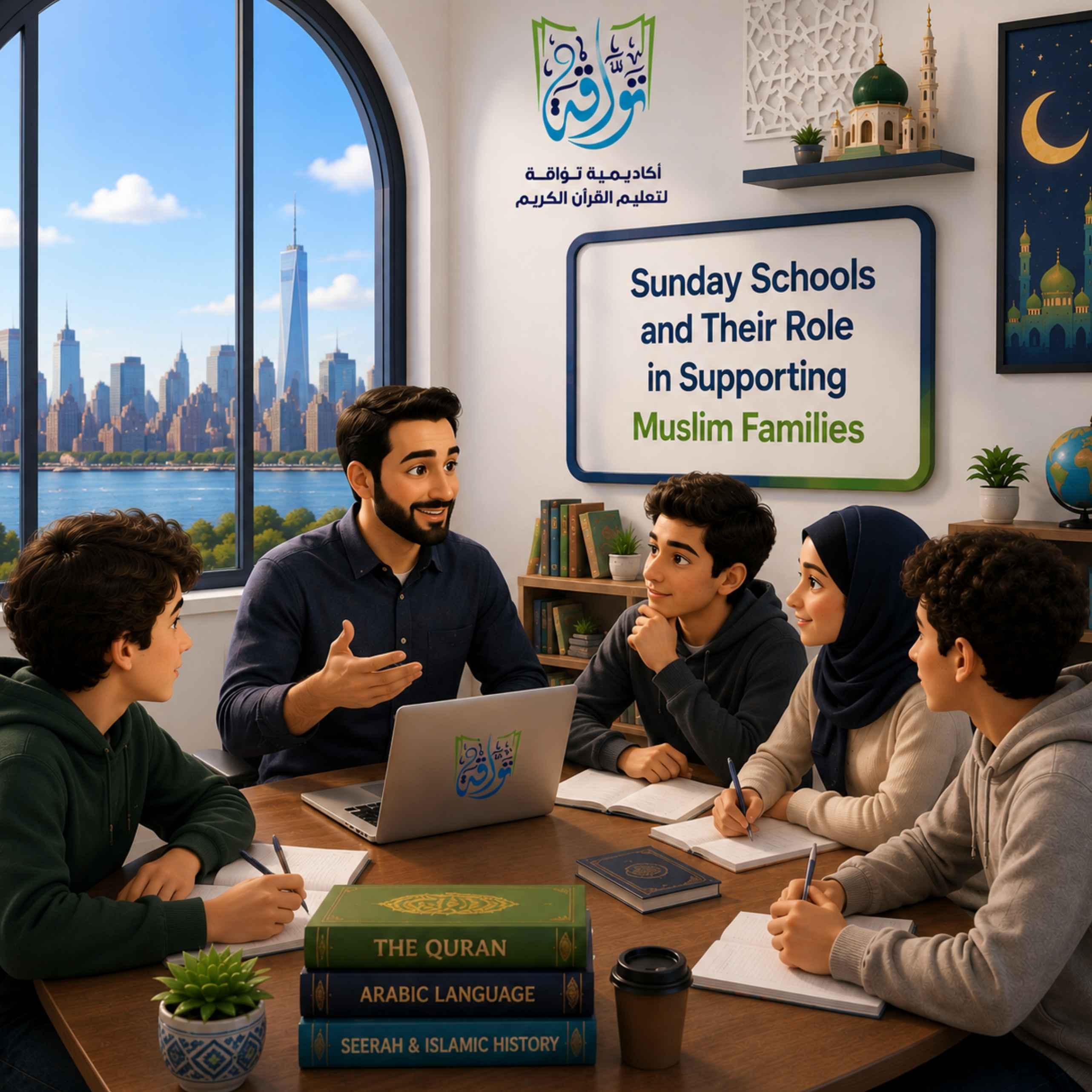
Sunday Schools and Their Role in Supporting Muslim Muslim Families
twaqah academy
Muslim parents living in Western countries such as the United States, Canada, the United Kingdom, Australia, and Western Europe face a daily challenge: preserving their children's Islamic identity and keeping them connected to their religious and cultural roots. This challenge obliges families to seek educational and upbringing channels that compensate for the knowledge gap left by Western mainstream schooling, providing a safe environment to learn Islamic studies and the Arabic language.
In this context, "Sunday Schools" have emerged as a strategic solution adopted by Muslim communities for decades. Today, this model has evolved into interactive online educational platforms, offering a practical, flexible solution to ensure authentic and continuous Islamic upbringing.
Historical Roots and Evolution of Sunday Schools
Historically, the concept of "Sunday Schools" originated in Great Britain during the late 18th century as a Christian initiative aimed at teaching underprivileged children reading, writing, and basic religious principles on their weekly day off. As Muslim immigrants established communities across the West during the 20th century, they found themselves navigating an educational system that occupies children five days a week. Consequently, it became imperative to utilize the weekend (Saturdays and Sundays) to build an educational fortress safeguarding the rising generation.
Islamic centers across North America and Europe borrowed and adapted this organizational structure to serve the Islamic faith. Sunday classrooms became spaces for teaching Arabic alphabets, short Quranic chapters (Surahs), and Islamic manners (Adab). As Muslim communities expanded geographically and demand grew, this educational model transitioned robustly into the digital sphere. Online learning has allowed families living in remote areas or countries lacking strong local Islamic infrastructure to access qualified, specialized native Arabic tutors and Quran scholars.
Pedagogical and Islamic Significance of Sunday Schools
The Muslim family carries a legal and spiritual responsibility before Allah regarding the upbringing of their children. Allah Almighty says:
[التحريم: 6] {يَا أَيُّهَا الَّذِينَ آمَنُوا قُوا أَنفُسَكُمْ وَأَهْلِيكُمْ نَارًا وَقُودُهَا النَّاسُ وَالْحِجَارَةُ}
"O you who have believed, protect yourselves and your families from a Fire whose fuel is people and stones." [Quran 66:6]
The importance of these schools rests upon several fundamental pillars:
1. Safeguarding Pure Fitrah and Instilling Correct Aqeedah (Creed)
Every child is born with an innate inclination toward truth. Prophet Muhammad (peace and blessings be upon him) clarified this meaning by saying:
«مَا مِنْ مَوْلُودٍ إِلَّا يُولَدُ عَلَى الْفِطْرَةِ، فَأَبَوَاهُ يُهَوِّدَانِهِ أَوْ يُنَصِّرَانِهِ أَوْ يُمَجِّسَانِهِ» [صحيح مسلم]
"No child is born except upon the natural disposition (Fitrah), then his parents make him a Jew, a Christian, or a Magian." [Sahih Muslim]
Sunday schools provide the essential weekly guidance needed to anchor the child's heart and mind in Tawheed (Monotheism), knowledge of the Prophet, and understanding the pillars of Islam and Iman (Faith) in a age-appropriate manner, answering the philosophical questions that may arise from their interactions with Western secular society.
2. Preserving the Arabic Language
Language is the vessel that preserves culture and faith. Without understanding Arabic, the new generation gradually becomes disconnected from comprehending the Glorious Quran and the Prophetic Sunnah. Allah Almighty says:
[يوسف: 2] {إِنَّا أَنزَلْنَاهُ قُرْآنًا عَرَبِيًّا لَّعَلَّكُمْ تَعْقِلُونَ}
"Indeed, We have sent it down as an Arabic Qur'an that you might understand." [Quran 12:2]
The methodologies adopted in these schools focus on teaching reading, writing, and conversation using modern Second Language Acquisition (SLA) techniques, strengthening the children's sense of belonging and family ties to their roots.
3. Cultivating Good Companionship and a Nurturing Environment
Children need a sense of belonging to a peer group sharing their core values. In Western schools, Muslim students may feel alienated or pressured to assimilate. Sunday classes—whether in-person or via interactive online classrooms—provide opportunities to build lasting friendships with Muslim peers from diverse backgrounds, reinforcing their confidence in their Islamic identity.
Educational Methodology in Sunday Schools
Specialized and professional academies rely on a structured, comprehensive curriculum tailored to the needs of students in the West, divided into three main tracks:
Holy Quran & Tajweed Track: Begins with foundational texts such as Al-Qaida Al-Nooraniyyah or Al-Baghdadiyyah to ensure precise pronunciation of Arabic letters, transitioning to memorizing short chapters with emphasis on simplified thematic understanding (Tafseer). It aims to instill love for Allah's Book and applying its ethics in daily life.
Arabic Language Track: Students are grouped by language proficiency rather than age. Curricula designed specifically for non-native Arabic speakers utilize interactive tools, illustrated stories, and gamified learning to build confidence in communication.
Islamic Studies Track: Covers Islamic Creed (Aqeedah), simplified Jurisprudence (Fiqh of purification and prayer), the Prophetic Biography (Seerah) taught through engaging narratives, and Islamic Character (Akhlaq).
Impact of Online Education on Sunday School Effectiveness
The shift toward e-learning represents a qualitative leap, addressing logistical and geographical hurdles for Western Muslim families:
Access to Certified Native Tutors: Local Islamic centers often face a shortage of qualified educators. Online education connects families in the US, UK, Canada, and Australia with expert tutors holding Quranic Ijazaat (authentic chains of transmission) and academic qualifications in teaching Arabic as a foreign language.
Flexibility and Time Saving: Eliminates long commutes to mosques during harsh weather or busy weekends, reducing absenteeism and dropouts.
Detailed Progress Tracking: Modern LMS platforms provide session recordings, homework submissions, and automated performance reports for parents.
The Role of the Family in Ensuring Educational Success
A teacher's weekly efforts require a complementary, supportive environment at home. Prophet Muhammad (peace and blessings be upon him) said:
«كُلُّكُمْ رَاعٍ وَكُلُّكُمْ مَسْئُولٌ عَنْ رَعِيَّتِهِ» [صحيح البخاري]
"Every one of you is a guardian and responsible for his charges." [Sahih Bukhari]
Family support is highlighted in three key actions:
Short Daily Revisions: Dedicating 10–15 minutes daily for Quran review and reading practice.
Practical Application: Encouraging children to practice Wudu, Salah, and manners taught in class.
Arabic-Friendly Home Environment: Incorporating formal/polite Arabic into everyday family conversations and media consumption.
Overcoming Challenges in Sunday Schools
Cultural Gap: Solved by choosing institutions that train tutors specifically on Western socio-cultural contexts.
Student Fatigue: Solved through interactive technologies, gamification, and student-centered active learning.
The Strategic Role of Online Academies
Dedicated online Islamic platforms serve as a vital extension of traditional Sunday schools, offering live interactive classes with certified scholars. Combining digital learning with consistent parental involvement creates an intellectual and spiritual sanctuary for young Muslims growing up in Western societies.
Twaqah Academy (twaqah.net): Your Trusted Partner for Islamic & Arabic Education
Parents seeking structured, high-quality Islamic and Arabic education for their children will find a dedicated online environment at Twaqah Academy (twaqah.net):
Independent Software Infrastructure: Custom-built parent dashboard providing complete privacy and real-time academic progress tracking.
Academic Discipline & Transparency: Strict evaluation criteria with automated performance reports sent after every live session.
Engaging Interactive E-Learning: Multimedia integration for teaching Tajweed, Arabic grammar, and Islamic studies effectively.
Certified Tutors (Ijazah Holders): Tutors holding authentic Quranic chains (Ijazaat) to Prophet Muhammad (peace and blessings be upon him), as well as Master's and Ph.D. degrees in Islamic Sciences. Profiles, credentials, and availability are transparently displayed for custom selection.
???? Book your free trial class today for any family member and explore our programs at twaqah.net.

Comments