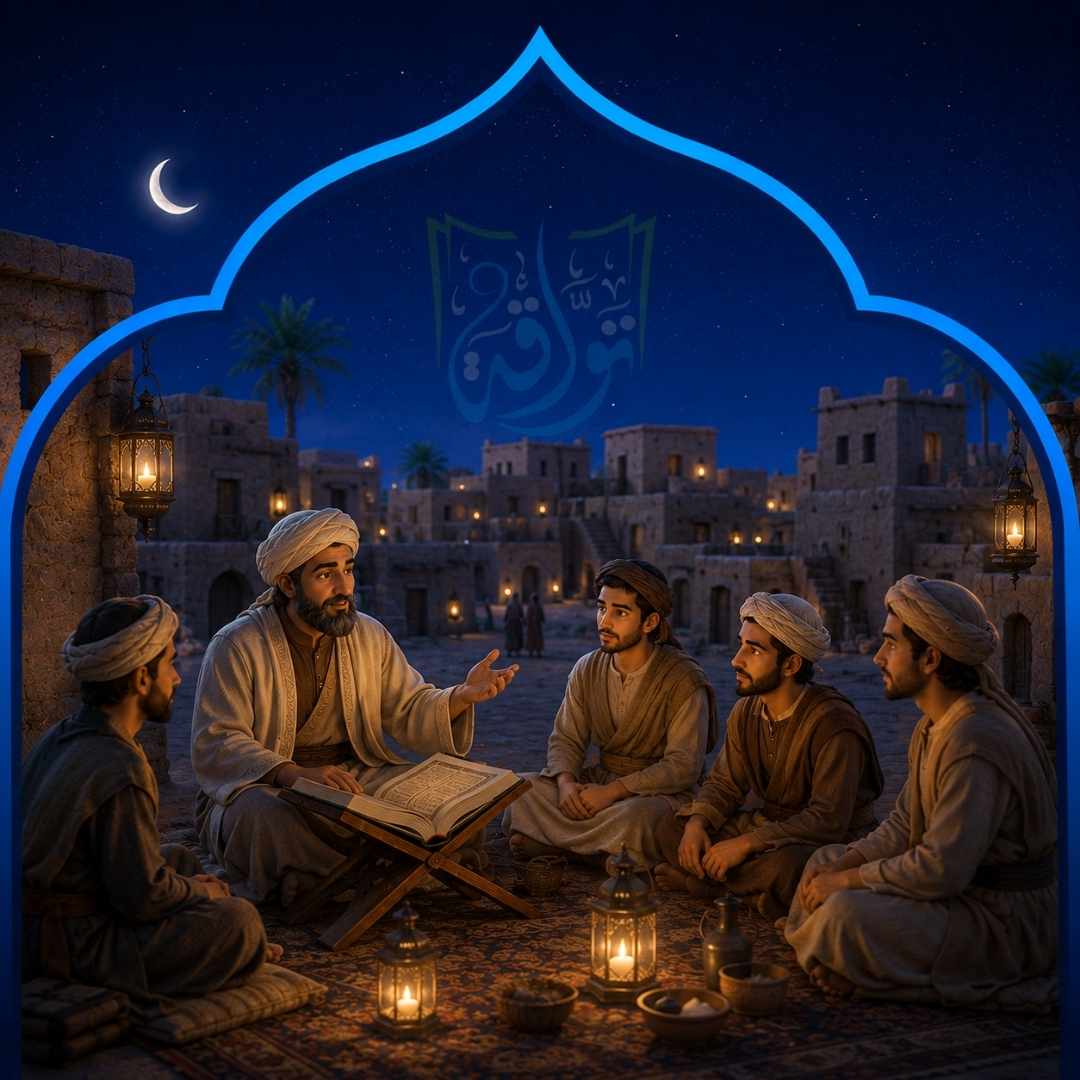
Imam Nafi‘ al-Madani
Dr. Jamal Ibrahim ‘Atta
The People of the Quran are the elite of creation. Allah the Almighty has chosen them to carry His Book, preserve His Words, and transmit His final revelation to mankind. Through them, the structural foundation of Islam—the Holy Quran—is safeguarded. As Allah the Almighty declares:
﴿ثُمَّ أَوْرَثْنَا الْكِتَابَ الَّذِينَ اصْطَفَيْنَا مِنْ عِبَادِنَا﴾
"Then We caused to inherit the Book those We have chosen of Our servants." [Surah Fatir: 32]
Those who memorize the Quran, embody its teachings, and implement its injunctions are recognized as the true folk of Allah and His chosen elite. In the Sunan of Imam Ibn Majah, it is narrated on the authority of Anas ibn Malik (may Allah be pleased with him) that the Messenger of Allah ﷺ said:
"Verily, Allah has His own folk among mankind." The companions asked, "O Messenger of Allah, who are they?" He replied, "They are the People of the Quran—the folk of Allah and His chosen elite."
Throughout Islamic history, noble souls have dedicated their lives to this majestic Book. They became uniquely identified by it, achieving widespread renown for mastering its science and dedicating themselves to its dissemination. Their names became permanently intertwined with the Book of Allah the Almighty. They emerged as radiant full moons in the celestial sky of Quranic studies, illuminating the path of learning for mankind and guiding them toward the most upright path.
The master scholar Imam Ash-Shatibi beautifully commemorated their legacy in his foundational didactic poem, Hirz al-Amani wa Wajh al-Tahani (commonly known as Al-Shatibiyyah), stating:
May Allah reward on our behalf with immense blessings those Imams... Who transmitted to us the Quran in its pure, sweet, and flowing form. Among them are 'seven full moons' who stood out uniquely... In the highest skies of excellence and justice, radiant and complete. They possess brilliant shooting stars (transmitters) from whom light was drawn... Illuminating the pitch blackness of the night until it completely dissipated.
In this biographical series, we embark on a comprehensive exploration of the Ten Canonical Reciters (Qurra') and their authorized transmitters (Ruwat), presented sequentially according to the established convention recognized by the masters of this sacred art.
Section I: Name, Lineage, and Agnomen (Kunyah)
He is Nafi‘ ibn ‘Abd al-Rahman ibn Abi Nu‘aym, Al-Laythi by virtue of clientage (wala’). He was known by the agnomens Abu Ruwaym and Abu ‘Abdillah. He is the master Quranic reciter of Madinah (Al-Muqri’ al-Madani). While his ancestral roots trace back to Isfahan (Persia), his legacy and renown were fully forged and established in the illuminated city of Madinah.
Section II: Physical and Moral Characteristics
Imam Nafi‘ possessed a very dark complexion, a radiant, cheerful countenance, and exemplary moral character. He was known for a pleasant, lighthearted sense of humor. A magnificent scent of pure musk would emanate from his mouth whenever he spoke.
He was once asked, "O Abu ‘Abdillah! Do you apply perfume every time you sit to teach Quranic recitation?" He replied: "I do not touch perfume. However, I once saw the Prophet ﷺ in a dream, and he was reciting the Quran directly into my mouth. Since that very moment, this fragrant musk scent has continuously emanated from my mouth." [See: Ma‘rifat al-Qurra’ al-Kibar, 1/108; Ghayat al-Nihayah, 2/332].
This extraordinary spiritual honor is precisely what Imam Ash-Shatibi alluded to in his poem, writing:
As for the one of noble inner secret regarding fragrance, Nafi‘... He is the one who chose the city of Madinah as his home.
Imam Nafi‘ was also asked, "How radiant is your face, and how beautiful is your character!" He responded, "How could I be otherwise when the Messenger of Allah ﷺ shook my hand, and I recited the entire Quran to him in a dream?" [Ghayat al-Nihayah, 2/332].
His prominent student, Imam Qalun, testified: "Nafi‘ was among the purest of people in moral character, and possessed one of the most beautiful recitations. He was a deeply ascetic (zahid) and exceptionally generous (jawad) man who led the congregational prayers in the Prophet’s Mosque ﷺ for sixty years."
In his methodology of teaching, he prioritized those who arrived first, regardless of their social standing or background. Furthermore, he possessed complete mastery over all authorized modes of recitation and taught his students using all of them [Jamal al-Qurra’, 2/447].
Abu Dihyah once questioned him, "O Abu Ruwaym, do you teach the people using all the various recitations?" Imam Nafi‘ replied: "Subhan Allah! Would I deprive myself of the immense reward of the Quran? I teach people according to all authorized recitations, and when a student specifically seeks my own preferred choice of reading (Harfi), I teach it to him." [Ghayat al-Nihayah, 2/304].
On another occasion, a man approached him and said, "Listen to my recitation according to the method of Hadr (rapid pacing)." Imam Nafi‘ replied: "What is Hadr? I do not recognize it in that manner; recite so we may hear." The man recited, and Nafi‘ instructed:
"Our method of rapid pacing (Hadr) ensures that we never drop the rules of grammatical inflection (I‘rab), we do not add emphasis (Tashdid) to a light letter, nor do we lighten an emphasized letter. We do not shorten a naturally elongated vowel (Madd), nor do we elongate a naturally short vowel. Our recitation is strictly the recitation of the senior companions of the Messenger of Allah ﷺ. It is smooth, eloquent, and precise. We do not mumble, chew our words, or speak unnaturally. We ease the pronunciation and do not exaggerate. We recite according to the most eloquent and current Arabic dialects, completely disregarding the poetic opinions or standard linguists. It is a tradition passed down from the seniors to the juniors... Our recitation is the recitation of the master scholars; we listen to the tradition of the Quran and we never implement personal opinion (Ra'y) within it." [Jamal al-Qurra’, 2/447]
Section III: Scholarly Academic Status
Imam Nafi‘ was an absolute authority and one of the seven renowned master reciters of the Islamic world. He achieved unmatched renown in Madinah, where leadership in the science of Quranic recitation (Riyasat al-Iqra’) ultimately culminated in him. He spent over seventy years teaching the Book of Allah.
The great jurist Imam Malik ibn Anas asserted: "Nafi‘ is the Imam of the people in recitation." He also stated on another occasion: "The recitation of the people of Madinah is a Sunnah (established prophetic tradition)." When asked, "Do you mean the recitation of Nafi‘?" He firmly replied, "Yes." [Ma‘rifat al-Qurra’ al-Kibar, 1/108].
‘Abdullah, the son of Imam Ahmad ibn Hanbal, narrated: "I asked my father: 'Which recitation is dearest to you?' He replied: 'The recitation of the people of Madinah (Nafi‘). If that is not accessible, then the recitation of ‘Asim.'" [Ma‘rifat al-Qurra’ al-Kibar, 1/108].
The famous philologist Al-Asma‘i stated: "I used to sit in the circles of Nafi‘ ibn Abi Nu‘aym, and he was truly among the scholarly reciters, jurists (Fuqaha’), and devoted worshippers (‘Ubbad*)."*
When the great Egyptian jurist Al-Layth ibn Sa‘d arrived in Madinah in the year 110 AH, he found Imam Nafi‘ standing as the undisputed, uncontested leader of recitation.
The master scholar Ibn Mujahid stated: "The Imam who stood at the absolute forefront of recitation in the city of the Messenger of Allah ﷺ after the generation of the Tabi‘un (Successors) was Nafi‘. He was deeply knowledgeable in the diverse facets of recitations, strictly following the tracks of the past Imams of his city."
Section IV: His Masters and Teachers in Recitation
Imam Nafi‘ studied and mastered recitation under a distinguished group of the Successors (Tabi‘un) in Madinah. Historical accounts indicate that he read directly under seventy individual Successors.
Among his most prominent teachers were:
‘Abd al-Rahman ibn Hurmuz al-A‘raj
Abu Ja‘far Yazid ibn al-Qa‘qa‘
Shaybah ibn Nisah
Yazid ibn Ruman
Muslim ibn Jundub
Nafi‘ (the noble client of Ibn ‘Umar)
‘Amir ibn ‘Abdillah ibn al-Zubayr
Abu al-Zinad
‘Abd al-Rahman ibn al-Qasim ibn Muhammad ibn Abi Bakr
Muhammad ibn Shihab al-Zuhri
Salih ibn Khawwat
Imam Ibn al-Jazari affirmed: "It has reached us through mutawatir (mass-transmitted, absolute) chains that he formally completed the full recitation of the Quran under the first five scholars listed above." [Ghayat al-Nihayah, 2/330].
‘Ubayd ibn Maymun al-Tabban narrated that Harun ibn al-Musayyib asked him: "Whose recitation do you teach?" I replied: "The recitation of Nafi‘." He asked, "Under whom did Nafi‘ recite?" I explained that he recited under Al-A‘raj. Al-A‘raj recited under the noble companion Abu Hurayrah (may Allah be pleased with him). Abu Hurayrah recited under Ubayy ibn Ka‘b, and Ubayy stated: "The Messenger of Allah ﷺ reviewed the Quran with me, saying: 'Jibril commanded me to review the Quran with you.'" [Al-Sab‘ah, p. 55].
Section V: Transmitters and Students of His Recitation
Imam Nafi‘ spent many decades teaching, drawing students from far and wide. Among the early generation of scholars who studied under him were his own peers, including:
Imam Malik ibn Anas
Isma‘il ibn Ja‘far
‘Isa ibn Wardan al-Hadhdha’
Sulayman ibn Muslim ibn Jammaz
Other prominent students included Ishaq al-Musayyibi, Al-Waqidi, Ya‘qub ibn Ibrahim ibn Sa‘d, Imam Qalun, Imam Warsh, Al-Asma‘i, and Abu ‘Amr ibn al-‘Ala’. His student Isma‘il ibn Abi Uways was the last of his direct students to pass away. [Ghayat al-Nihayah].
Section VI: Status in Hadith Transmission and Narrator Criticism
Imam Nafi‘’s scholarly contributions were not confined to the Quran; he was also a narrator of Hadith, though he narrated a relatively small number of traditions (Qalil al-Riwayah).
He transmitted Hadith from master scholars such as: Rabi‘ah ibn Abi ‘Abd al-Rahman, Zayd ibn Aslam, Safwan ibn Sulaym, ‘Amir ibn ‘Abdillah ibn al-Zubayr, Abu al-Zinad, ‘Abd al-Rahman ibn al-Qasim, Al-A‘raj, Muhammad ibn ‘Imran al-Talhi, Muhammad ibn Yahya ibn Habban, Nafi‘ (client of Ibn ‘Umar), Yazid ibn Ruman, Abu Ja‘far, and Al-Layth ibn Sa‘d.
In turn, Hadith were narrated from him by: Ishaq al-Musayyibi, Isma‘il ibn Ja‘far, Khalid ibn Makhlad al-Qatawani, ‘Abdullah ibn Maslamah al-Qa‘nabi, Al-Asma‘i, ‘Ubayd ibn Maymun, Imam Warsh, Imam Qalun, and Al-Waqidi.
Because his historical precision and absolute mastery were primarily channeled into the oral preservation of the Quran rather than the technical transmission lines of Hadith, scholars of Hadith criticism (Jarh wa Ta‘dil) expressed differing views regarding his strength as a Hadith transmitter. As Imam Adh-Dhahabi noted, none of the compilers of the Six Canonical Books of Hadith (Al-Kutub al-Sittah) extracted narrations through him. However, despite these technical differences, his narrations remain acceptable (Maqbul).
Yahya ibn Ma‘in authenticated him (wathaqahu).
Ahmad ibn Hanbal considered him slightly weak in Hadith transmission, stating: "The Quran would be taken from him, but in Hadith, he is not a primary authority."
An-Nasa’i stated: "There is nothing wrong with him (Laysa bihi ba’s)."
Abu Hatim al-Razi stated: "He is truthful, sound in Hadith (Saduq salih al-hadith)."
Ibn Hibban and Al-‘Ijli explicitly included him in their biographical works of trustworthy narrators (Al-Thiqat).
Ibn ‘Adi concluded: "I have never seen a single rejected or anomalous (Munkar) narration attributed to him, and I hold that there is nothing wrong with him."
Section VII: Death and Final Legacy
Imam Nafi‘ ibn Abi Nu‘aym passed away in the illuminated city of Madinah in either the year 169 AH or 170 AH. As he lay on his deathbed, his children gathered around him and requested, "O father, leave us a final parting counsel." He responded by reciting the words of Allah the Almighty:
﴿فَاتَّقُوا اللَّهَ وَأَصْلِحُوا ذَاتَ بَيْنِكُمْ وَأَطِيعُوا اللَّهَ وَرَسُولَهُ إِنْ كُنْتُمْ مُؤْمِنِينَ﴾
"So fear Allah and amend that which is between you, and obey Allah and His Messenger, if you should be believers." [Surah Al-Anfal: 1]
Written by: Dr. Jamal Ibrahim ‘Ata Ph.D. in Islamic Propagation and Culture, Al-Azhar University

Comments