2 years ago
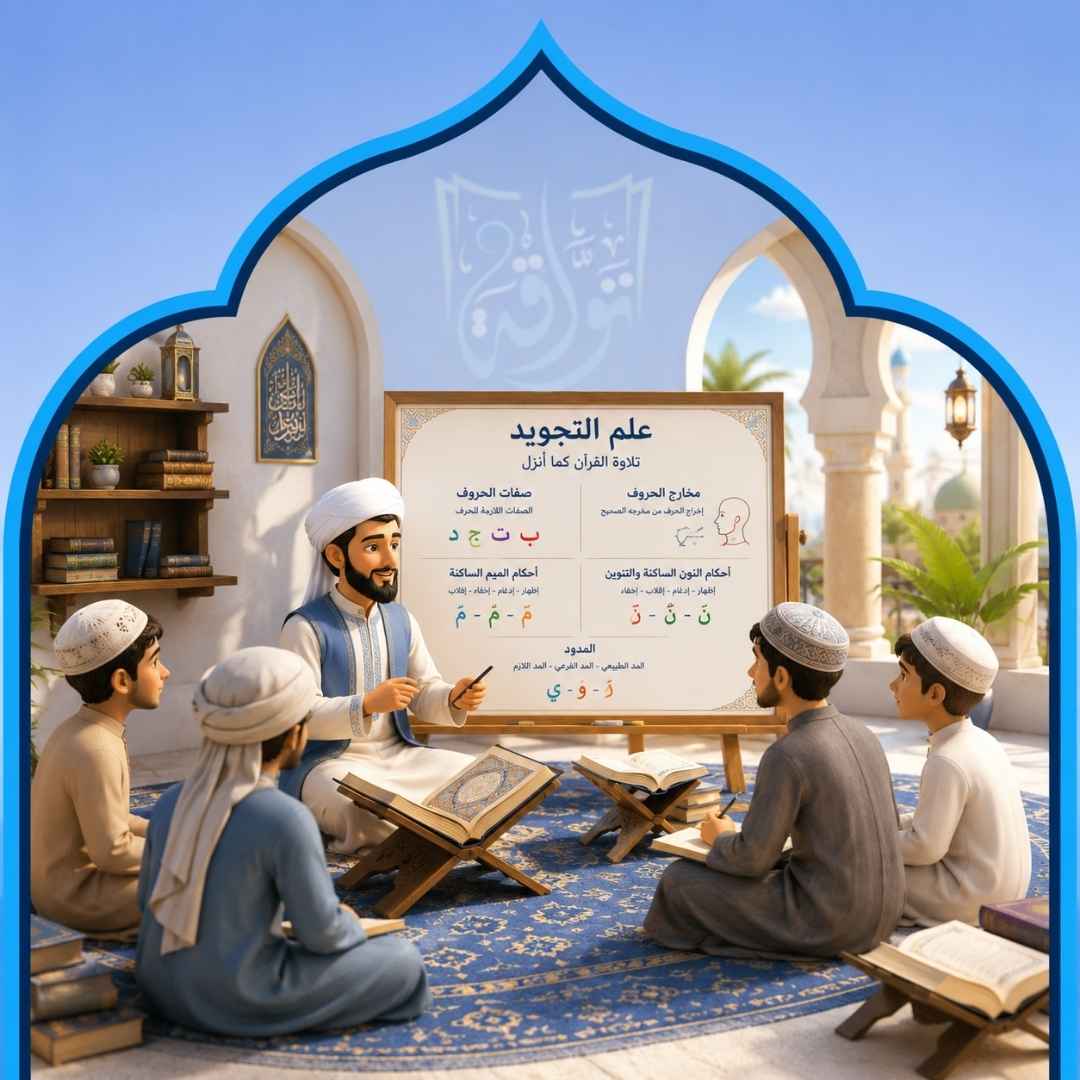
The Holy Quran is the word of Allah revealed to His Prophet Muhammad (peace be upon him), the constitution of this Ummah (nation) and its beacon that illuminates its paths. Its recitation is an act of worship (ibadah), contemplating its verses is a conduct, and acting upon it leads to success in this world and the Hereafter. But is it enough to simply read the Quran? Or is there a special way of recitation that ensures its majesty and beauty? Herein lies the importance of Tajweed, which is not merely about vocal enhancement, but rather a noble science concerned with articulating each letter from its correct articulation point (makhraj) and giving it its due rights and characteristics (sifat and ahkam). Learning and teaching Tajweed is a safeguard for the proper pronunciation of the Quran, preserving it from errors (lahn), and ensuring the continuity of its recitation as it was revealed to the heart of the Messenger of Allah (peace be upon him).
The first thing that comes to mind when discussing Tajweed is the beauty of sound and excellent performance, and this is an integral part of Tajweed's reality, but it is not everything. Tajweed, at its core, is the preservation of the Holy Quran's pronunciation from falling into clear (jali) or subtle (khafi) errors. A clear error is one that changes the meaning of the word, such as substituting one letter for another, or one vowel for another, which can lead to a change in the intended meaning of the verse, and consequently may result in corruption in understanding or even in belief. As for a subtle error, it is a change that occurs in pronunciation but does not alter the meaning; however, it detracts from the beauty of recitation and proper performance, such as not giving the nasal sounds (ghunnah) their full right, or hiding the prolongations (mudood).
Allah (SWT) says in His Noble Book:
﴿وَرَتِّلِ الْقُرْآنَ تَرْتِيلًا﴾ [المزمل: 4]
"And recite the Qur'an with a measured recitation." [Al-Muzzammil: 4]
This noble verse is a clear and direct call to Tartil (measured recitation) of the Quran. Tartil is Tajweed itself; it is reading with deliberation and understanding, articulating the letters from their correct points of articulation while giving them their proper characteristics. Imam Ibn Al-Jazari clarifies in his famous introduction: "And taking to Tajweed is a definite obligation; whoever does not apply Tajweed to the Quran is sinful."
Learning Tajweed opens new horizons for contemplation (tadabbur) and reverence (khushu') during Quranic recitation. When a Muslim recites the Quran with Tajweed and proficiency, he interacts deeply with the verses, sensing the grandeur of the Divine speech. The words emerge from his mouth correctly and clearly, which helps him to grasp the meanings and be affected by them. This interaction is not merely reading verses, but a spiritual dialogue between the servant and his Lord, in which reverence for Allah's words is manifested. How can it be befitting for a Muslim to read the words of his Creator and Sovereign without giving it its due right of Tartil and Tajweed?
On the authority of Aisha (may Allah be pleased with her), she said: The Messenger of Allah (peace be upon him) said:
"الماهر بالقرآن مع السفرة الكرام البررة، والذي يقرأ القرآن ويتتعتع فيه وهو عليه شاق له أجران" [صحيح مسلم، رقم الحديث: 798]
"The one who is proficient in the Qur'an will be with the noble and righteous scribes (angels), and the one who reads the Qur'an and stutters over it, finding it difficult, will have two rewards." [Sahih Muslim, Hadith No: 798]
This noble Hadith encourages mastering recitation and striving for Tajweed. The high rank is for the one who is proficient in the Quran, meaning the one who recites it with Tajweed and excellence. This does not mean that the one who stutters is not rewarded; rather, he has two rewards: one for reciting and one for the difficulty, which is from Allah's mercy and grace.
Tajweed is built upon essential pillars, which are:
Knowledge of the articulation points (makharij) of the letters: These are the places from which the letter emerges from the mouth, such as the lips, tongue, throat, and empty space (jawf).
Knowledge of the characteristics (sifat) of the letters: These are the qualities that describe a letter upon its articulation, such as audible and whispered (jahr and hams), strong and soft (shiddah and rakhawah), elevation and lowering (isti'la and istifal), adhesion and openness (itbaq and infitah).
Knowledge of Tajweed rules (ahkam): These are the rules that govern how letters are recited when they combine, such as the rules of noon sakina and tanween (pronunciation izhar, assimilation idgham, conversion iqlab, concealment ikhfa), the rules of meem sakina, prolongations (mudood), echoing (qalaqalah), and others.
Practice and application: Knowledge alone is not enough; practical application and exercise under the supervision of a proficient teacher are essential.
Mastering these pillars leads to a correct and proficient Quranic recitation, free from errors that might change the meaning or detract from the beauty of performance.
Teaching Tajweed is, in essence, teaching the Book of Allah, and it is among the greatest acts of worship and obedience. The one who teaches people the Quran opens for them the doors of guidance and light, and will have a share in the reward of everyone who reads the Quran because of him. This is a tremendous virtue, priceless.
On the authority of Uthman ibn Affan (may Allah be pleased with him) that the Prophet (peace be upon him) said:
"خيركم من تعلم القرآن وعلمه" [صحيح البخاري، رقم الحديث: 5027]
"The best among you are those who learn the Quran and teach it." [Sahih Al-Bukhari, Hadith No: 5027]
This Hadith explicitly states the virtue of the teacher and learner of the Quran, placing him in the position of "the best of people." This includes learning and teaching Tajweed, as it is an integral part of learning and teaching the Quran in the correct manner that pleases Allah the Almighty.
The world has witnessed tremendous developments in distance learning in recent years, and learning the Quran and Tajweed online has become accessible to many who cannot reach traditional Quranic circles. Online Quran teaching platforms offer a great opportunity for Muslims everywhere to learn Tajweed rules from specialized and authorized teachers. This technological advancement has not diminished the importance of Tajweed; rather, it has increased access to it.
Through interactive audio and video lessons, students can correct their recitation directly with the teacher, review lessons at any time, and maintain continuous communication with their instructors. This ensures the continuity of the learning and correction process, leading to proficiency in recitation and Tajweed. Platforms like twaqah.net contribute to achieving this noble goal by offering Quran and Arabic language education remotely using systematic and effective methods that cater to all student levels.
Learning Tajweed brings immense benefits to individuals and society, including:
Correct understanding of meanings: When you recite the Quran with Tajweed, you reduce the likelihood of errors that might change the meanings, which helps in correctly understanding Allah's intentions in His verses.
Reverence and contemplation: Correct and proficient recitation increases khushu' (reverence) and being affected by the Quran, which strengthens one's connection with Allah and increases faith.
Preservation of the Quran: Tajweed is a means of preserving the Holy Quran from distortion and errors in pronunciation, ensuring the continuity of its recitation as it was revealed.
Attaining great reward: Every letter you recite from the Quran brings ten good deeds, so how much more if that letter is recited with perfect Tajweed? The reward is multiplied, and the grace is immense.
Emulating the Prophet (peace be upon him): The Prophet (peace be upon him) used to recite the Quran with deliberation and contemplation, which is the essence of Tajweed. Learning Tajweed is an emulation of his noble Sunnah.
Strengthening the Arabic language: Tajweed relies heavily on knowing the articulation points and characteristics of Arabic letters, which strengthens eloquence and clear expression for the learner.
The first step to learning Tajweed is sincerity to Allah the Almighty and a firm resolve. This is followed by seeking a proficient and authorized teacher who possesses the necessary experience and knowledge to teach Tajweed rules and correct recitation. Such teachers can be found through specialized online Quran teaching platforms from here.
Allah (SWT) says:
﴿وَلَقَدْ يَسَّرْنَا الْقُرْآنَ لِلذِّكْرِ فَهَلْ مِن مُّدَّكِرٍ﴾ [القمر: 17]
"And We have certainly made the Qur'an easy for remembrance, so is there any who will remember?" [Al-Qamar: 17]
This verse instills hope in hearts, as Allah the Almighty has made the Quran easy for remembrance, understanding, and learning. Thus, a Muslim should take advantage of this ease and strive to learn and master it.
In conclusion, learning and teaching Tajweed of the Holy Quran is not merely an academic achievement or a vocal skill; rather, it is a great act of worship and a noble means of drawing closer to Allah the Almighty. It is the best way to recite the words of Allah as they were revealed, and to preserve them from any error or distortion. Let our earnest endeavor be towards mastering the recitation of our Lord's Book, and let us be keen to teach this noble science to our children and those around us, so that we may attain the immense reward and be among the people of the Quran who are Allah's special chosen ones. Let us make Tajweed an integral part of our lives, reciting Allah's verses with it so that our hearts find tranquility and our souls are purified. Is there any who will take heed and strive for this exalted status?
Request a free trial class for the Tajweed learning program for men from here.
Request a free trial class for the Tajweed learning program for women from here.


د/ محمد نور الدين
ما شاء الله نفع الله بك وبارك في جهودكم
د/ محمد نور الدين
ما شاء الله نفع الله بك وبارك في جهودكم