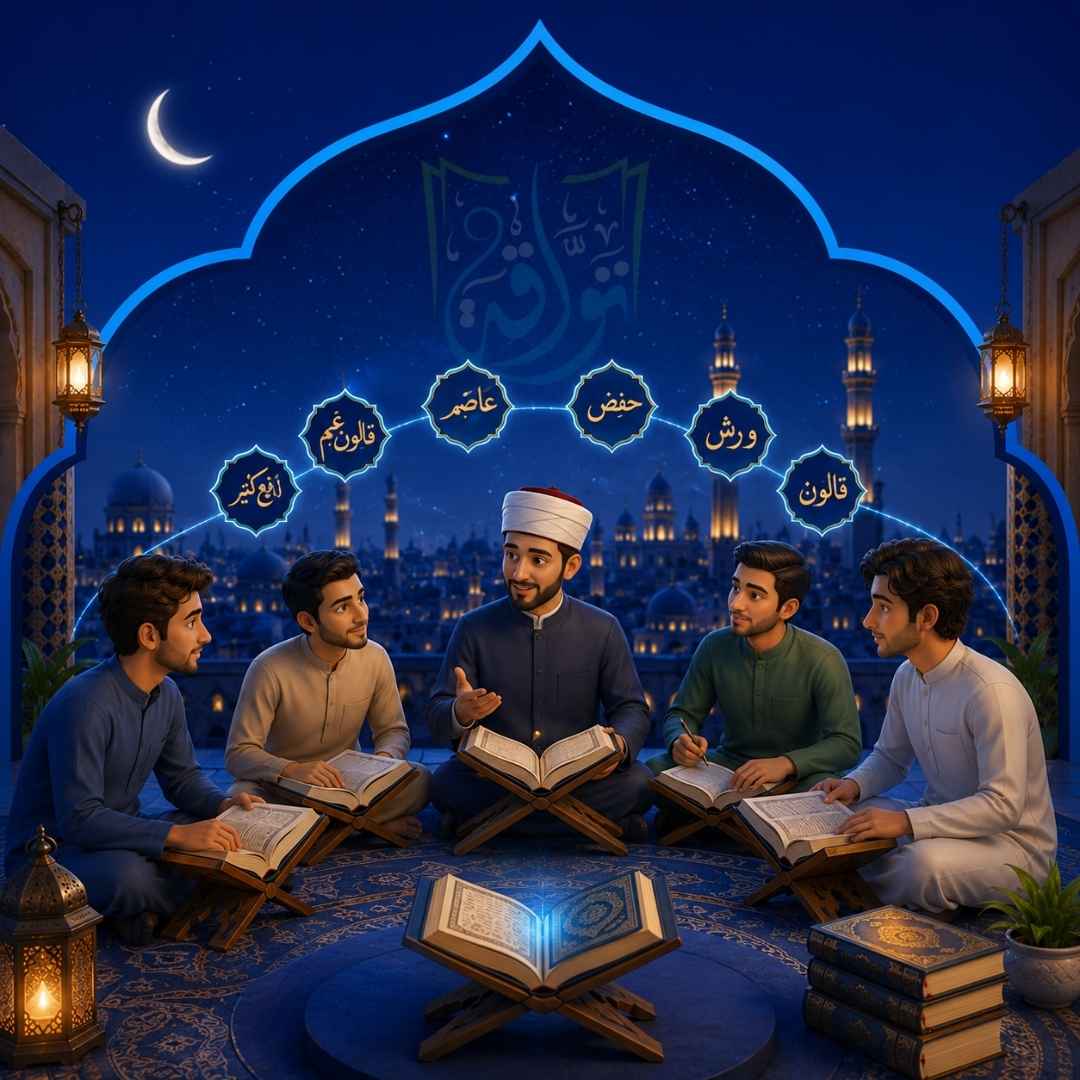
An Introduction to the Science of Quranic Recitations (Qira'at)
الشيخ محمد علي يوسف
In the Name of Allah, the Most Gracious, the Most Merciful. All praise is due to Allah, Lord of the Worlds, and peace and blessings be upon the most honorable of messengers, our master Muhammad, the trustworthy Prophet, and upon his family and all his companions.
To proceed:
The Revelatory Stages of the Holy Quran
The Holy Quran was originally preserved as a complete and comprehensive divine record, deposited by Allah the Almighty in the Preserved Tablet (Al-Lawh Al-Mahfuz). Defining its celestial status, Allah the Almighty states:
﴿بَلْ هُوَ قُرْآنٌ مَجِيدٌ فِي لَوْحٍ مَحْفُوظٍ﴾
"But this is an honored Quran, [inscribed] in a Preserved Tablet." [Surah Al-Buruj: 21-22]
Subsequently, the Holy Quran descended in its entirety from the Preserved Tablet to be securely stationed at the House of Honor (Bayt al-Izzah) in the lowest heaven. This momentous event occurred during the holy month of Ramadan, as Allah the Almighty declares:
﴿شَهْرُ رَمَضَانَ الَّذِي أُنْزِلَ فِيهِ الْقُرْآنُ هُدًى لِلنَّاسِ وَبَيِّنَاتٍ مِنَ الْهُدَى وَالْفُرْقَانِ﴾
"The month of Ramadan [is that] in which was revealed the Quran, a guidance for the people and clear proofs of guidance and criterion." [Surah Al-Baqarah: 185]
Allah then specified the blessed timing of this descent, stating:
﴿إِنَّا أَنْزَلْنَاهُ فِي لَيْلَةٍ مُبَارَكَةٍ إِنَّا كُنَّا مُنْذِرِينَ﴾
"Indeed, We sent it down during a blessed night. Indeed, We were to warn." [Surah Al-Dukhan: 3]
He further defined the exact timeframe of this revelation, stating:
﴿إِنَّا أَنْزَلْنَاهُ فِي لَيْلَةِ الْقَدْرِ﴾
"Indeed, We sent the Quran down during the Night of Decree." [Surah Al-Qadr: 1]
Following this cosmic descent, the Quran was revealed sequentially to the Messenger of Allah ﷺ in stages, structural segments, and in response to historical occurrences and events over a span of approximately 23 years—13 years of which were spent in Makkah and 10 years in Madinah. Allah the Almighty states:
﴿وَقُرْآنًا فَرَقْنَاهُ لِتَقْرَأَهُ عَلَى النَّاسِ عَلَى مُكْثٍ وَنَزَّلْنَاهُ تَنْزِيلًا﴾
"And [it is] a Quran which We have divided [into parts] that you might recite it to the people at intervals. And We have sent it down progressively." [Surah Al-Isra: 106]
The Codification and Linguistic Diversity of the Revelation
As the divine revelation descended, the Prophet ﷺ strictly instructed the scribes of the revelation to commit the text to writing. This scriptural codification occurred directly in his presence ﷺ. Upon completion, he would order the scribe to read aloud what had been written. If any accidental omission or textual slip occurred, the Prophet ﷺ would instantly rectify and amend it.
During this initial phase, the Quran was revealed in a single, unified mode of recitation. However, as tribes embraced Islam in massive numbers and the faith rapidly expanded, the Holy Quran continued to descend upon the Messenger of Allah ﷺ in the eloquent classical Arabic tongue, which perfectly aligned with the linguistic dialect of the Quraysh tribe at that time. Allah the Almighty notes:
﴿وَكَذَلِكَ أَوْحَيْنَا إِلَيْكَ قُرْآنًا عَرَبِيًّا﴾
"And thus We have revealed to you an Arabic Quran..." [Surah Al-Shura: 7]
Historically, the Arabs were organized into distinct regional tribes and communities, each possessing its own linguistic nuances, variations, and oral traditions—a reality that persists to this day. Even during the prophetic era, certain tribes naturally inclined toward phonetic assimilation (Idgham), vowel facilitation (Tashil), or phonetic inclination (Imalah).
Out of divine mercy for His servants, Allah permitted minor phonetic modifications that matched the habitual speech patterns of these tribes, provided the variations did not alter the core theological meaning, but rather enriched or strengthened it—such as the structural variations between pronouncing a word as Yu'minun or Yuminun.
As vast populations entered Islam, the necessity arose for diverse peoples to master the Quran, yet they did not all share the specific linguistic tongue of Quraysh. Addressing this accessibility, Allah the Almighty states:
﴿وَلَقَدْ يَسَّرْنَا الْقُرْآنَ لِلذِّكْرِ فَهَلْ مِنْ مُدَّكِرٍ﴾
"And We have certainly made the Quran easy for remembrance, so is there any who will remember?" [Surah Al-Qamar: 17]
He also states:
﴿بِلِسَانٍ عَرَبِيٍّ مُبِينٍ﴾
"In a clear Arabic language." [Surah Al-Shu'ara: 195]
The Prophetic Traditions on the Seven Modes (Ahruf)
True linguistic clarity and eloquence (Bayan) naturally necessitate a multiplicity of structural and oral expressions. Consequently, the Quran descended in multiple authorized recitations (Qira'at) to accommodate the complex nuances of the multi-faceted Arabic tongue.
It is narrated on the authority of Abdullah ibn Abi Bakr, from his father, that the Archangel Jibril (Gabriel), peace be upon him, said:
"Ya Muhammad, recite the Quran in one mode (Harf)." Mikail (Michael) then whispered to the Prophet, "Ask for more." So he requested an increase until it reached seven distinct modes. Jibril then concluded: "Recite the Quran in seven modes; each of them is sufficient and restorative, so long as a verse of punishment is not concluded with mercy, or a verse of mercy with punishment."
Imam Muslim recorded in his Sahih via his chain of transmission from Ubayy ibn Ka'b that the Messenger of Allah ﷺ was near the water pool of the Banu Ghifar tribe in Madinah when Jibril came to him and said:
"Verily, Allah commands you to teach your nation to recite the Quran in one mode (Harf)." The Prophet ﷺ replied, "I ask Allah for His pardon and forgiveness; my nation lacks the capacity to bear that." Jibril returned a second time and said, "Verily, Allah commands you to teach your nation to recite the Quran in two modes." The Prophet ﷺ repeated, "I ask Allah for His pardon and forgiveness; my nation lacks the capacity to bear that." Jibril came a third time and said, "Verily, Allah commands you to teach your nation to recite the Quran in three modes." The Prophet ﷺ again replied, "I ask Allah for His pardon and forgiveness; my nation lacks the capacity to bear that." Jibril approached for the fourth time and declared, "Verily, Allah commands you to teach your nation to recite the Quran in seven modes (Sab'at Ahruf). Whichever of these modes they recite, they will be entirely correct."
Furthermore, Imam At-Tirmidhi recorded from Ubayy ibn Ka'b that the Messenger of Allah ﷺ met Jibril and expressed his concern, saying:
"O Jibril! I have been sent to an unlettered nation, among whom are the frail elderly, the aged matriarchs, and young children." Jibril replied, "O Muhammad, command them to recite the Quran in seven modes."
Understanding the Numerical Concept of "Seven"
When analyzing the term "seven modes" (Sab'at Ahruf), we must observe an essential aspect of classical Arabic rhetoric. The number seven can denote the precise mathematical integer following the number six, or it can be utilized rhetorically to signify absolute multiplicity, hyperbole, or vast abundance.
An example of this linguistic convention is found in the statement of Allah the Almighty:
﴿اسْتَغْفِرْ لَهُمْ أَوْ لَا تَسْتَغْفِرْ لَهُمْ إِنْ تَسْتَغْفِرْ لَهُمْ سَبْعِينَ مَرَّةً فَلَنْ يَغْفِرَ اللَّهُ لَهُمْ ذَلِكَ بِأَنَّهُمْ كَفَرُوا بِاللَّهِ وَرَسُولِهِ وَاللَّهُ لَا يَهْدِي الْقَوْمَ الْفَاسِقِينَ﴾
"Ask forgiveness for them or do not ask forgiveness for them. If you should ask forgiveness for them seventy times—never will Allah forgive them. That is because they disbelieved in Allah and His Messenger, and Allah does not guide the defiantly disobedient people." [Surah Al-Tawbah: 80]
Does this scriptural context imply that if the Prophet ﷺ had sought forgiveness seventy-one times, Allah would have automatically forgiven the hypocrites? Absolutely not. Rather, Allah the Almighty invoked the number seventy purely as a rhetorical tool for hyperbole and emphasis—meaning that regardless of how frequently or immensely you seek forgiveness for them, Allah will never grant them pardon.
Correspondingly, within this textual context, the designation of "seven modes" does not strictly denote its literal mathematical value, but serves as a rhetorical indication of linguistic expansive choice and textual abundance. This profound concept will be detailed comprehensively in our upcoming article, if Allah wills.
Written by: The Reader of the Ten Minor and Ten Major Recitations, Sheikh Muhammad Ali Youssef

Comments