1 year ago
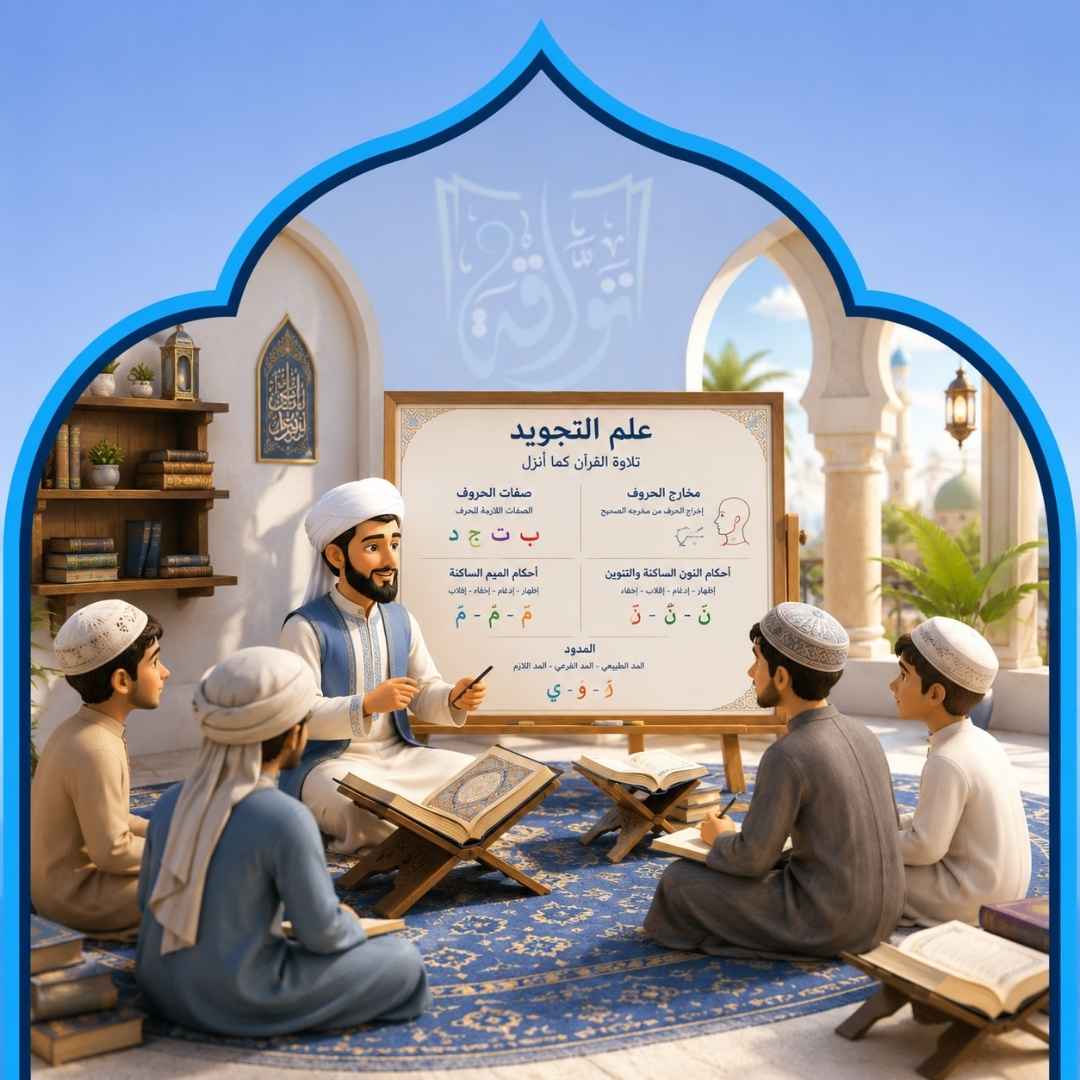
Praise be to Allah, and peace and blessings be upon the Messenger of Allah ﷺ. Welcome, O People of the Quran. I have chosen this specific branch of knowledge—the Science of Tajweed and Quranic Recitations (Qira'at)—due to its critical importance for every Muslim man and woman. Through this science, one learns how to recite the Book of Allah in the manner that pleases Him, exactly as it was revealed to the Messenger of Allah ﷺ and transmitted down to us.
The Science of Tajweed is universally recognized as one of the most honorable and loftiest sciences in existence. Its supreme nobility stems directly from its subject matter: the Final Word of Allah. The honor of any field of study is directly proportional to the nobility of the subject it serves.
We will explain this science in a simplified, step-by-step methodology across sequential stages, if Allah wills. I pray that Allah blesses you all and ordains us to be among the Folk of the Quran—the true folk of Allah and His chosen elite.
The following are the specific structural chapters we will cover throughout this educational course, by the permission of Allah the Almighty:
Introductory definitions to the Science of Tajweed
The Rules of Isti'adhah (Seeking refuge with Allah)
The Rules of Basmalah (In the Name of Allah)
The Rules of Noon Sakinah (Sakinah/静止) and Tanween (Nunnation) in absolute detail
The Rules of emphasized Noon and Meem (Mushaddadatain)
The Levels of Ghunnah (Nasalization)
The Rules of Meem Sakinah and Meem Al-Jam’ (Plural Meem)
The Rules of Lam Mutaharrikah and Sakinah (Lamat Al-Sawakina)
Tafkheem (Velarization/Thickening) and Tarqeeq (Attenuation/Thinning)
The Rules of Qalqalah (Vibration/Echoing Consonants)
Al-Madd (Elongation) and Al-Qasr (Shortening), alongside the classifications of Elongations.
A Qira'ah is the specific linguistic and phonetic methodology of reading the Quranic text attributed to a master Imam among the primary Imams of recitation. This methodology is based entirely on how the Imam received the text via direct oral dissemination (Mushafahah) through an unbroken, authentic chain of transmission (Sanad) back to the Messenger of Allah ﷺ. Examples include the Recitation of Imam Nafi‘ and the Recitation of Imam ‘Asim.
The Qari or Imam is the foundational scholar to whom a specific school of Quranic recitation is attributed—such as the Reciter Nafi‘ or the Reciter ‘Asim. Every primary Imam possesses two authorized primary transmitters (Ruwat). For instance, Imam Nafi‘ transmits through Qalun and Warsh, while Imam ‘Asim transmits through Shu'bah and Hafs.
A Rawi is a scholar who learned the recitation directly from the primary master Qari and transmitted it on his authority, whether through direct teacher-student instruction or via an intermediary link. For example, Qalun and Warsh are the two transmitters from Imam Nafi‘, while Shu'bah and Hafs are the two transmitters from Imam ‘Asim.
A Tareeq is the chain of transmission attributed to anyone who transmits from the primary Rawi, down through subsequent generations of transmitters. For example, we state: "Hafs on the authority of ‘Asim via the route (Tareeq) of Ash-Shatibiyyah," or "Warsh on the authority of Nafi‘ via the route of Al-Azraq."
He is ‘Asim ibn Abdullah ibn Bahdalah Abi al-Nujud al-Kufi. His mother's name was Bahdalah. He was an illustrious scholar from the generation of the Tabi‘un (Successors) and was known by his agnomon (Kunyah) Abu Bakr. He is one of the foundational Seven Canonical Reciters of the Quran.
The ultimate leadership of Quranic instruction (Mashiakhat al-Iqra') in Kufa culminated in him following the death of Abu Abd al-Rahman al-Sulami. People traveled to him from all corners of the world to learn the Quran. He uniquely combined eloquence, pristine Tajweed, perfect textual precision, and meticulous verification. He possessed one of the most beautiful voices when reciting the Holy Quran. He passed away, may Allah have mercy on him, in the year 127 AH.
He is Hafs ibn Sulayman ibn al-Mughirah, Abu ‘Amr ibn Abi Dawud al-Asadi al-Kufi al-Bazzaz. He was called Al-Bazzaz because he traded in garments (Al-Bazz). Born in the year 90 AH, he acquired the canonical Quranic recitations through rigorous, comprehensive evaluation and oral presentation ('Ardan).
Like any technical science or classical art, the Science of Tajweed is built upon ten foundational principles (Al-Mabadi al-‘Asharah). A student of Islamic knowledge must comprehend them to grasp the unique characteristics and methodology of this discipline. These ten principles were beautifully codified in verse by master scholars:
إِنَّ مَبَادِي كُلِّ فَنٍّ عَشَرَهْ ... الحَدُّ وَالمَوْضُوعُ ثُمَّ الثَّمَرَهْ وَنِسْبَةٌ وَفَضْلُهُ وَالْوَاضِعْ ... وَالاسْمُ الاسْتِمْدَادُ حُكْمُ الشَّارِعْ مَسَائِلٌ وَالبَعْضُ بِالبَعْضِ اكْتَفَى ... وَمَنْ دَرَى الجَمِيعَ حَازَ الشَّرَفَا
Verily, the foundational principles of every science are ten: The definition (Had), the subject matter (Mawdu'), and the fruit (Thamarah); The lineage (Nisbah), its virtue (Fadl), and the founder (Wadi'); The name (Ism), the source of derivation (Istimdad), and the legal ruling of the Lawgiver (Hukm al-Shari'); The specific technical issues (Masa'il). Gaining familiarity with some is sufficient for some, But whoever masters all ten attains absolute honor.
Linguistic Definition: It is the verbal noun derived from Jawwada (جَوَّدَ), meaning to beautify, refine, or excel. Therefore, Tajweed linguistically denotes "beautification or optimization."
Technical Islamic Definition: It is the articulation of every single letter from its correct point of articulation (Makhraj), while granting the letter its intrinsic rights (Haqq) and its conditional dues (Mustahaqq).
The Right of the Letter (Haqq al-Harf): Refers to its permanent, non-separable phonetic characteristics (Sifat Lazimah) that never leave it, such as whispering (Hams) or vocal clarity (Jahr).
The Conditional Due of the Letter (Mustahaqq al-Harf): Refers to temporary or incidental phonetic traits (Sifat ‘Aridah) that apply to a letter under specific structural conditions and disappear in others—such as the thickening (Tafkheem) or thinning (Tarqeeq) applied to the letter Raa.
Applied/Practical Tajweed (Amali التطبيقي): The actual application of rhythmic, measured recitation (Tarteel) while reading the Holy Quran correctly.
Theoretical/Conceptual Tajweed (Ilmi النظري): Gaining cognitive comprehension of the formal rules of articulation, such as clear pronunciation (Izhhar), assimilation (Idgham), and elongation (Madd). It is technically named The Science of Tajweed.
The subject matter of this science focuses exclusively on Quranic words. It analyzes them to ensure every letter is granted its exact phonetic right and conditional due, avoiding both unnatural affectation and negligent mispronunciation.
The primary objective and reward of mastering Tajweed is safeguarding the tongue from Lahn (linguistic/phonetic errors or deviation from correct recitation when reading the Book of Allah the Almighty). By protecting the tongue from error, the reciter ensures complete spiritual reward, attains the pleasure of his Lord, and achieves ultimate success in this life and the Hereafter.
Methodology for Protecting the Tongue from Errors:
Thoroughly mastering the points of articulation of letters (Makharij al-Huroof).
Deeply understanding their phonetic characteristics (Sifat).
Mastering the structural rules governing Quranic words.
Consistent oral training, repetition, and continuous physical practice of the tongue.
The Science of Tajweed is one of the core Sharia (Islamic jurisprudential) sciences directly connected to the Holy Quran, as its legal rulings and structural boundaries are derived entirely from Islamic law.
From a Practical, Applied Aspect: The founder is our master, the Messenger of Allah ﷺ, who received the Quran orally from the Archangel Jibril (Gabriel) (peace be upon him), who received it directly from the Lord of Glory (Mighty and Majestic is He). The Companions (Sahabah) then took it directly from the lips of the Prophet ﷺ, transmitting it to the Successors (Tabi‘un), passing it down sequentially via unbroken, authentic oral mass-transmission (Tawatur) to our current day.
From a Theoretical, Codified Aspect: (The formalization of technical rules, textual principles, and academic chapters). There is scholarly disagreement regarding who first committed the rules to text. It is famously attributed to either: the master linguist Al-Khaleel ibn Ahmad al-Farahidi, Abu al-Aswad al-Du'ali, Hafs ibn ‘Umar al-Duri, or the collective body of the early master Imams of recitation.
The Science of Tajweed is indisputably one of the most noble and exalted sciences due to its direct connection to the speech of Allah. The honor of a field of study is elevated by the absolute sanctity of what it serves.
The scholars of performance and master reciters derived this science directly from the exact oral methodology with which Jibril recited to the Messenger of Allah ﷺ, and the manner in which the Prophet ﷺ himself recited. This exact auditory form reached us through the Companions, the Successors, and generations of continuous auditory transmission via chains of narration (Saneed) directly connected to the Prophet ﷺ.
The noble Sharia has mandated that anyone who intends to recite the Holy Quran must do so utilizing correct Tajweed. This correct performance is made the conditional prerequisite for attaining complete spiritual reward. The Messenger of Allah ﷺ explicitly differentiated between a proficient reciter and a struggling one:
عَنْ عَائِشَةَ رَضِيَ اللَّهُ عَنْهَا قَالَتْ: قَالَ رَسُولُ اللَّهِ صَلَّى اللَّهُ عَلَيْهِ وَسَلَّمَ: «الَّذِي يَقْرَأُ القُرْآنَ وَهُوَ مَاهِرٌ بِهِ مَعَ السَّفَرَةِ الكِرَامِ البَرَرَةِ، وَالَّذِي يَقْرَأُ القُرْآنَ وَيَتَتَعْتَعُ فِيهِ وَهُوَ عَلَيْهِ شَاقٌّ لَهُ أَجْرَانِ». [متفق عليه]
It is narrated by ‘A'ishah (may Allah be pleased with her) that the Messenger of Allah ﷺ said: "The one who recites the Quran and is proficient in it will be with the noble and righteous scribes (angels). And the one who recites the Quran and stumbles over it, finding it difficult, will have a double reward." [Al-Bukhari and Muslim].
Therefore, the legal ruling is categorized into two aspects:
Theoretical Study (Academic Rules): It is a Communal Obligation (Fard Kifayah). If a specialized segment of the community masters it, the legal responsibility is lifted from the general public.
Practical Application during Recitation: It is an Individual Obligation (Fard ‘Ayn) upon every single Muslim who intends to recite any portion of the Holy Quran.
Evidence from the Holy Book: Allah the Almighty states:
{وَرَتِّلِ الْقُرْآنَ تَرْتِيلًا} [المزمل: 4]
"And recite the Quran with measured recitation." [Surah Al-Muzzammil: 4].
The grammatical form here is an absolute imperative command (Amr), which structurally establishes an individual legal obligation (Wujoob), since no textual evidence exists to divert this command toward mere recommendation or option.
Evidence from the Purified Sunnah: The Messenger of Allah ﷺ stated, as narrated by Abu Hurayrah (may Allah be pleased with him):
عَنْ أَبِي هُرَيْرَةَ رَضِيَ اللَّهُ عَنْهُ قَالَ: سَمِعْتُ رَسُولَ اللَّهِ صَلَّى اللَّهُ عَلَيْهِ وَسَلَّمَ يَقُولُ: «مَا أَذِنَ اللَّهُ لِشَيْءٍ مَا أَذِنَ لِنَبِيٍّ حَسَنِ الصَّوْتِ يَتَغَنَّى بِالْقُرْآنِ يَجْهَرُ بِهِ». [رواه البخاري ومسلم]
"Allah has never listened to anything as He listens to a Prophet with a beautiful voice reciting the Quran aloud in a melodious, measured tone." [Al-Bukhari and Muslim].
Furthermore, it is verified via Musa ibn Yazid al-Kindi (may Allah be pleased with him) who narrated: "Abdullah ibn Mas‘ood was once teaching a man to recite. The man recited the following verse flatly without any vowel elongation:
{إِنَّمَا الصَّدَقَاتُ لِلْفُقَرَاءِ وَالْمَسَاكِينِ} [التوبة: 60]
'Alms are only for the poor and the needy' [Surah Al-Tawbah: 60].
He read the word 'Al-Fuqara' shortly (without elongation). Ibn Mas‘ood stopped him and exclaimed: 'This is not how the Messenger of Allah ﷺ taught me to recite it!' The man asked: 'O Abu Abd al-Rahman, how did he teach you to recite it?' Ibn Mas‘ood replied: 'He taught it to me like this,' and he elongated the word with its mandatory connected elongation (Al-Madd al-Wajib al-Muttasil) for four rhythmic counts." [Recorded by Al-Albani in Silsilat al-Ahadith al-Sahihah, 5/279]. This text explicitly proves that Ibn Mas‘ood firmly rebuked the man for failing to elongate the word correctly, establishing a clear textual proof for the absolute obligation of reciting the Quran with correct Tajweed rules.
Evidence from Scholarly Consensus (Ijma‘): An absolute consensus has been established within the Islamic Nation from the era of the Prophet ﷺ down to our modern era, declaring that reciting the Quran according to the verified phonetic rules of Tajweed is mandatory. No scholar has ever deviated from this consensus.
The master authority of reciters, Imam Ibn al-Jazari, famously codified this obligation in his masterpiece (Al-Muqaddimah al-Jazariyyah):
وَالأَخْذُ بِالتَّجْوِيدِ حَتْمٌ لازِمُ ... مَنْ لَمْ يُجَوِّدِ الْقُرْآنَ آثِمُ لأَنَّهُ بِهِ الإِلَهُ أَنْزَلاَ ... وَهَكَذَا مِنْهُ إِلَيْنَا وَصَلاَ وَهْوَ أَيْضاً حِلْيَةُ التِّلاَوَةِ ... وَزِينَةُ الأَدَاءِ وَالْقِرَاءَةِ
And adopting Tajweed is an absolute individual obligation; Whoever does not recite the Quran with Tajweed is sinful. For it is precisely with Tajweed that God sent it down, And exactly thus has it reached us from Him. It is also the true adornment of recitation, And the ultimate elegance of performance and reading.
Summary of Legal Status: Theoretical knowledge is a Communal Obligation (Fard Kifayah), while practical application during recitation is an Individual Obligation (Fard ‘Ayn).
Technical Scope of Inquiry: The Science of Tajweed investigates a structured set of universal principles and foundational rules. Through these rules, a reciter can master the detailed specifics of vocal application, such as the rules of vowel elongation (Madd) versus shortening (Qasr), and the phonetics governing the Noon Sakinah and Tanween.
Collected and Edited by: Sheikh Hilmi Badawi Master Instructor of Tajweed and Canonical Recitations
How to Memorize the Holy Quran Efficiently with a Busy Schedule?
Learn the Holy Quran via Distance Education with Twaqah Academy
The Absolute Etquettes and Manners of Quranic Recitation
The Linguistic and Spiritual Meaning of the Term 'Twaqah'
The Immense Virtues of the Mighty Quran
Imam Nafi‘ al-Madani: Biographical Profile of the Master Reciter
An Introduction to the Science of Quranic Recitations (Qira'at)
The Sublime Virtues of the Quran and Our Individual Duty Towards It
Al-Itqan fi Ulum al-Quran by Imam Al-Suyuti
Al-Taysir fi Ulum al-Quran
Al-Tajweed al-Mubassat (Simplified Tajweed)
Al-‘Ameed fi Ilm al-Tajweed
Explanation of Al-Muqaddimah al-Jazariyyah by Sheikha Hala Sarhan (May Allah preserve and protect her)


Comments