3 months ago
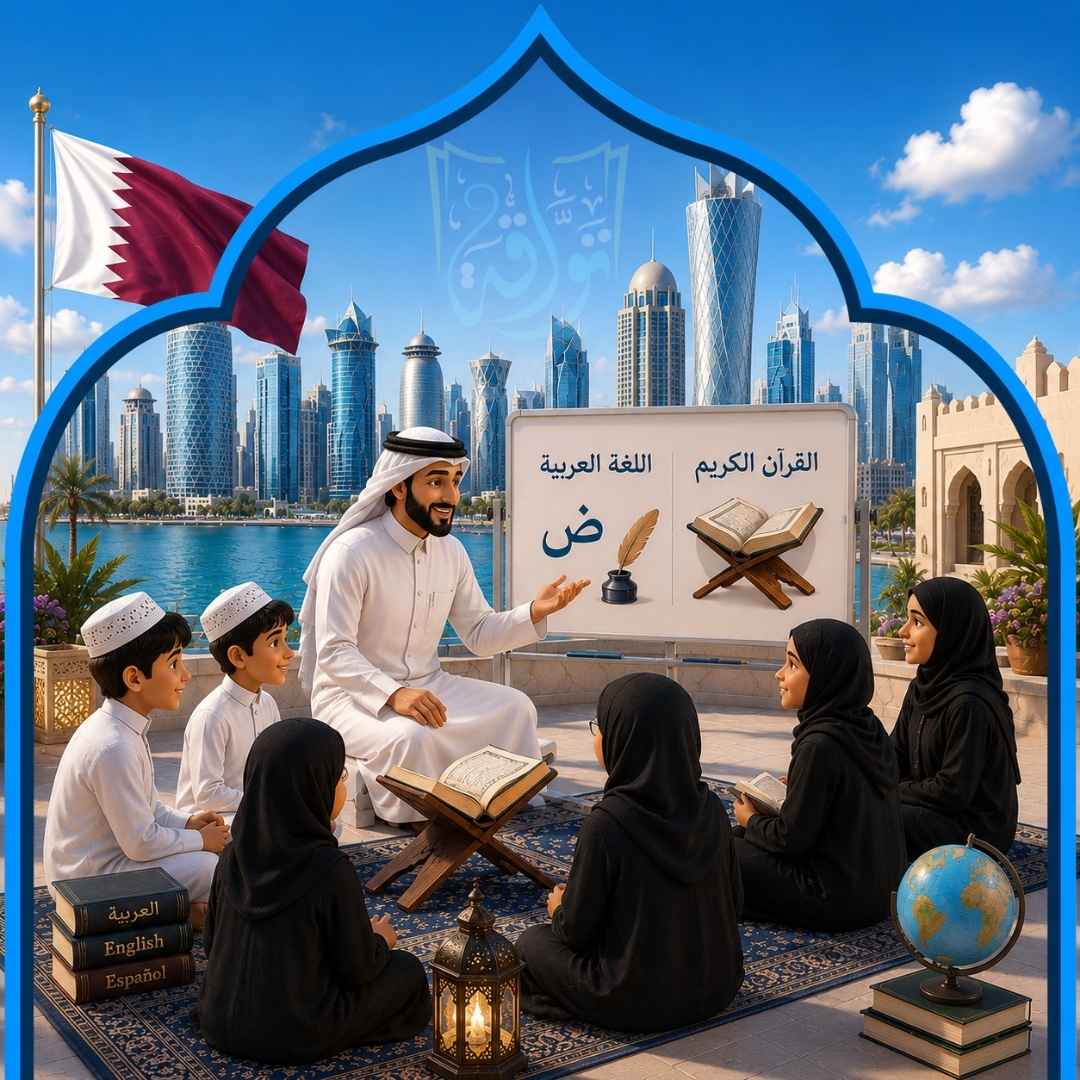
How does online Quran learning preserve Islamic identity in Qatar?
Establishing a sound Islamic creed to counter contemporary intellectual challenges.
Integrating Quranic courses in state schools to protect youth from cultural alienation.
Keeping the Arabic language alive and vibrant as the language of revelation and culture.
Investing in summer programs to build a balanced, ethical, and leadership-oriented personality.
Building a generation that combines authenticity with safe openness to modern technologies.
The Holy Quran as a Cultural Shield to Protect Qatari Identity in the Age of Globalization All praise is due to Allah, Lord of the worlds, and peace and blessings be upon the one sent as a mercy to the worlds, our Master Muhammad bin Abdullah, his family, his companions, and those who follow his path until the Day of Judgment.
To proceed: An insightful observer of the paths of contemporary nations realizes with certainty that material architecture, no matter how tall and prosperous, remains fragile if it does not rest on a solid spiritual foundation and deep cultural roots. In this era, where the waves of globalization crash and cultures intertwine to the point of blurring essential distinctions between societies, preserving identity stands as the greatest existential challenge.
The wisdom and profound vision of the State of Qatar have manifested in its early realization of this delicate equation. It understood that the remarkable technical and urban development the country is witnessing must be accompanied by a deeper and more comprehensive human development. Hence, it took the utmost care of the Book of Allah the Almighty as an indispensable strategic path. The issue of teaching the Quran and preserving the Islamic identity in Qatar is not merely a slogan raised on occasions; rather, it is a daily institutional and societal practice aimed at building a generation connected to its Lord, proud of its language, and fortified with its supreme values.
Allah the Almighty has guaranteed the preservation of this eternal constitution, and in its preservation lies the preservation of the Ummah (nation) and its identity, as stated in His words: (إِنَّا نَحْنُ نَزَّلْنَا ٱلذِّكْرَ وَإِنَّا لَهُۥ لَحَـٰفِظُونَ) {Indeed, it is We who sent down the message [i.e., the Qur’ān], and indeed, We will be its guardian.} [Al-Hijr: 9]. Imam Muhammad al-Tahir ibn Ashur alluded to the secret of this preservation in his book "Tafsir al-Tahrir wa'l-Tanwir" (Vol. 14, p. 25), saying: "The preservation of the Quran entails the preservation of the religion, its language, and the nation in which it was revealed, because its survival among them requires their survival as its protectors, and the survival of its language, which is the vessel of its meanings." From this spiritual and academic standpoint, we explore how the Holy Quran has become the strongest cultural shield in Qatari society.
The Strategic Role of the Qatari Ministry of Education in Integrating Quranic Courses The brilliant balance that the State of Qatar maintains between global openness and Islamic affiliation did not come from a vacuum. It is the fruit of carefully studied educational policies led by the Ministry of Education and Higher Education.
Pioneering Initiatives: Fortifying Independent and International Schools with Islamic Education The Ministry has worked to root Islamic education and the Holy Quran as core subjects in all educational stages. These sincere efforts did not stop at the borders of independent government schools but extended to include the private and international school sectors. Compelling foreign schools to teach Islamic education and the Quran to Muslim students carries a clear message: openness to the languages and sciences of the world does not mean abandoning the components of the Islamic personality. This comprehensive vision perfectly aligns with the higher objectives (Maqasid) of Islamic Sharia. Imam Ibrahim bin Musa Al-Shatibi establishes this view in his foundational book "Al-Muwafaqat fi Usul al-Shari'ah" (Vol. 2, p. 65), affirming that "The Lawgiver only intended by legislation to establish both worldly and otherworldly interests together."
Organizational Decisions: Strategies for Protecting the Arabic Language and Rooting Identity In addition to teaching the Holy Quran, Qatari educational institutions have issued a series of strict organizational decisions ensuring the priority of the Arabic language as a primary language of instruction. Integrating Quranic texts into the curricula of the Arabic language, history, and national education provides a holistic educational environment.
Quran Memorization Centers in Qatar: Living Incubators for Raising Youth Alongside official school efforts, the role of community incubators emerges as the lungs through which society breathes the fragrance of revelation. Hundreds of Quranic centers and memorization circles (Halaqat) are spread across Qatar, embracing thousands of sons and daughters.
The Efforts of the Ministry of Awqaf and Islamic Affairs The Ministry of Awqaf and Islamic Affairs plays a vital and sustainable role in managing these centers. By providing prepared environments, attracting the best certified male and female teachers (Mujazeen), and allocating massive budgets to sponsor local and international Quranic competitions, these centers have transformed into integrated educational institutions. We recall here what Hujjat al-Islam Abu Hamid al-Ghazali wrote in his immortal work "Ihya' 'Ulum al-Din" (Vol. 1, p. 275), emphasizing that "Understanding and pondering the Quran is the ultimate goal, and reciting it properly inherits humility in the heart and submissiveness in the limbs."
Summer Programs for Quran Learning: Investing Time in Building Values One of the most successful strategies in Qatar is investing long free times during summer school holidays. Annually, the state launches a package of summer programs for teaching the Holy Quran. These programs transform into vibrant educational clubs where memorizing the Book of Allah blends with purposeful cultural and recreational activities.
Protecting the Language of Dhad: The Quran and Arabic as Two Sides of One National Identity It is impossible to separate the Holy Quran and the Arabic language; they are two sides of one coin: "Islamic Identity." In a multinational society like Qatar, linguistic challenges emerge strongly. Here, the Holy Quran plays its great role as the faithful guardian of the Arabic language.
Eloquence and Articulation: The Impact of Early Memorization on the Qatari Student's Tongue Allah has honored this language by making it the language of His final address to humanity: (إِنَّا أَنزَلْنَـٰهُ قُرْءَٰنًا عَرَبِيًّا لَّعَلَّكُمْ تَعْقِلُونَ) {Indeed, We have sent it down as an Arabic Qur’ān that you might understand.} [Yusuf: 2]. The involvement of Qatari children in memorization circles from an early age rectifies pronunciation issues, trains the tongue on proper eloquence, and enriches their vocabulary. Imam of grammarians, Abu al-Fath Uthman ibn Jinni, established this in his pioneering book "Al-Khasa'is" (Vol. 1, p. 40), confirming Arabic's uniqueness in its vast semantic scope and expressive power that embraced the revelation.
Contemporary Cultural Challenges: How the Quranic Curriculum Addresses Identity Crises We live today in the era of knowledge explosion, where millions of media messages are broadcast daily, carrying values that may contradict sound human nature and religious constants.
Psychological and Behavioral Fortification: Building a Moral Fence The Quranic curriculum represents the moral fence and psychological shield that protects youth from slipping into cultural alienation. The Prophet (PBUH) left us a comprehensive will: («تَرَكْتُ فِيكُمْ أَمْرَيْنِ لَنْ تَضِلُّوا مَا تَمَسَّكْتُمْ بِهِمَا: كِتَابَ اللهِ وَسُنَّةَ نَبِيِّهِ») "I have left among you two things; you will never go astray as long as you hold fast to them: the Book of Allah and the Sunnah of His Prophet." (Hasan Hadith, Muwatta Malik, Book of Al-Jami', p. 899). Imam Badr al-Din al-Zarkashi explains the impact of this revelation on human behavior in his encyclopedia "Al-Burhan fi 'Ulum al-Quran" (Vol. 1, p. 200), saying: "In the Great Quran, there are deterrents of sermons and commands of wisdom that break the evil of the commanding souls and lead them with the reins of obedience to their Lord."
Utilizing Modern Technology to Serve the Holy Quran in Qatar Educational and Da'wah institutions in Qatar did not stop at traditional methods but rushed to harness modern technology to serve the Book of Allah, making the learning process highly attractive to the digital generation.
Interactive Digital Platforms and AI Apps Teaching methods have witnessed a qualitative leap through the integration of interactive whiteboard technologies and smart worksheet systems in blended and remote learning environments. Relying on advanced systems that allow screen sharing and interactive drawing (similar to the advanced "Awraq" systems for shared whiteboards) creates real-time interaction between the teacher and the student. Furthermore, Artificial Intelligence (AI) applications have emerged as complementary tools for evaluating Tajweed recitation and identifying articulation errors (Makharij).
The Close Integration Between Family and Educational Institutions The efforts of schools and technical centers are incomplete without a conscious family incubator. Parents bear a immense responsibility in making the Holy Quran part of the daily fabric of family life. The Prophet (PBUH) said: («خَيْرُكُمْ مَنْ تَعَلَّمَ القُرْآنَ وَعَلَّمَهُ») "The best among you (Muslims) are those who learn the Qur'an and teach it." (Sahih Bukhari, Book of the Virtues of the Quran, Hadith No. 5027, p. 192).
FAQ about Online Quran Learning and Preserving Identity in Qatar
What are the most prominent summer programs for memorizing the Quran in Qatar? The Ministry of Awqaf organizes specialized programs focusing on recitation, Tajweed, and retention, alongside recreational activities.
How do I register my child in accredited memorization centers in Qatar? Registration is easily done through the Ministry of Awqaf's electronic portal or by visiting the nearest Quranic center.
What is the role of international schools in teaching Islamic education in Qatar? Under strict directives, international schools are obligated to teach Islamic studies, Arabic, and Qatari history to Muslim students.
Preserving Identity is a Shared Responsibility Requiring a Safe Educational Environment Preserving the Islamic and Arab identity of our children amid rapid changes is a great responsibility that requires providing a safe, professional, and reliable educational environment. In this context, we invite parents and educators to optimally invest their children's time by joining the Twaqah Platform (twaqah.net).
Twaqah offers a pioneering educational experience in online Quran and Arabic language learning, allowing students to study comfortably and safely from home (you can request a free trial class). The platform relies primarily on a system of direct, one-on-one interactive sessions (a private online tutor for each student). It is an integrated digital platform featuring dedicated programs for kids, men, and women, offering Quranic Ijazah (certification) for proficient reciters. Furthermore, Twaqah is proud to host an exclusive elite of male and female teachers who hold a connected chain of transmission (Sanad) to the Messenger of Allah (PBUH). They are all native Arab speakers whose first language is Arabic, ensuring the teaching of the Holy Quran with the highest degrees of mastery and Tajweed, building a generation proud of its religion and identity.

الشيخ محمد زيدان
اللهم بارك .. وفقها الله وسددها وأصلح حالها وجميع بلاد المسلمين